Three sub-ranks, four Pyung Ahn forms, and the techniques where color belt training stops being introductory — 6th gup through 3rd gup.
- 3Rank levels
- 4Forms
- 50+Lessons
- ∞Lifetime access
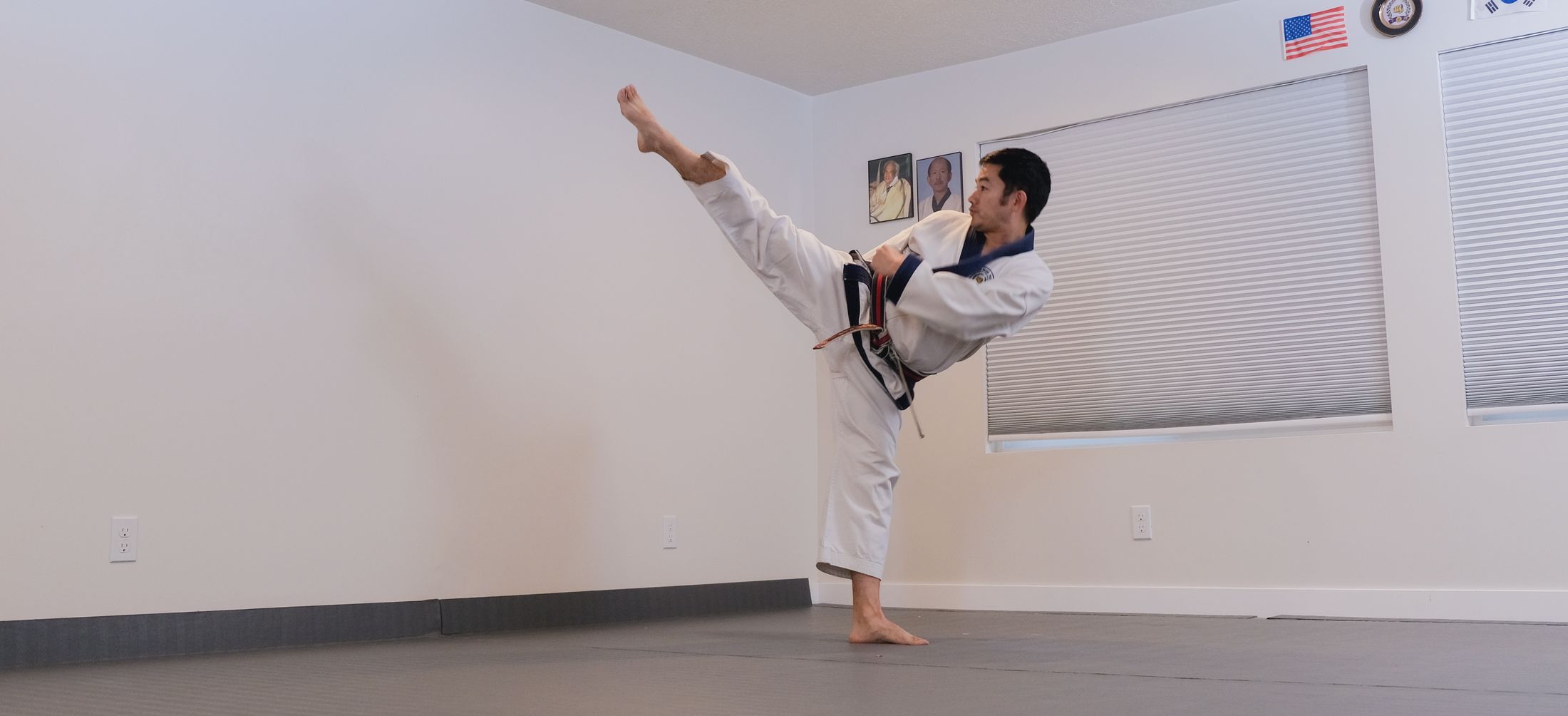
Precision through practice.
Every technique broken down with training drills.
Where the forms get real
Four Pyung Ahn forms, from Cho Dan to Sa Dan
Green belt is where Tang Soo Do and Soo Bahk Do students move past the introductory Ki Cho set and into the Pyung Ahn line — the same forms known as Pinan or Heian in Okinawan and Japanese karate. Four forms across three sub-ranks, each one longer and more technical than the last.
The physical demands step up too: back kick, resistance training, and combinations that string techniques together instead of drilling them in isolation. Most students spend close to a year in green belt alone.
This is the third step on the path — Foundations gets you to your first stripe, White/Orange Belt takes you through 6th gup, and this picks up exactly where that one left off. Already training green belt material elsewhere? It works as a second set of eyes on the forms you're learning now.
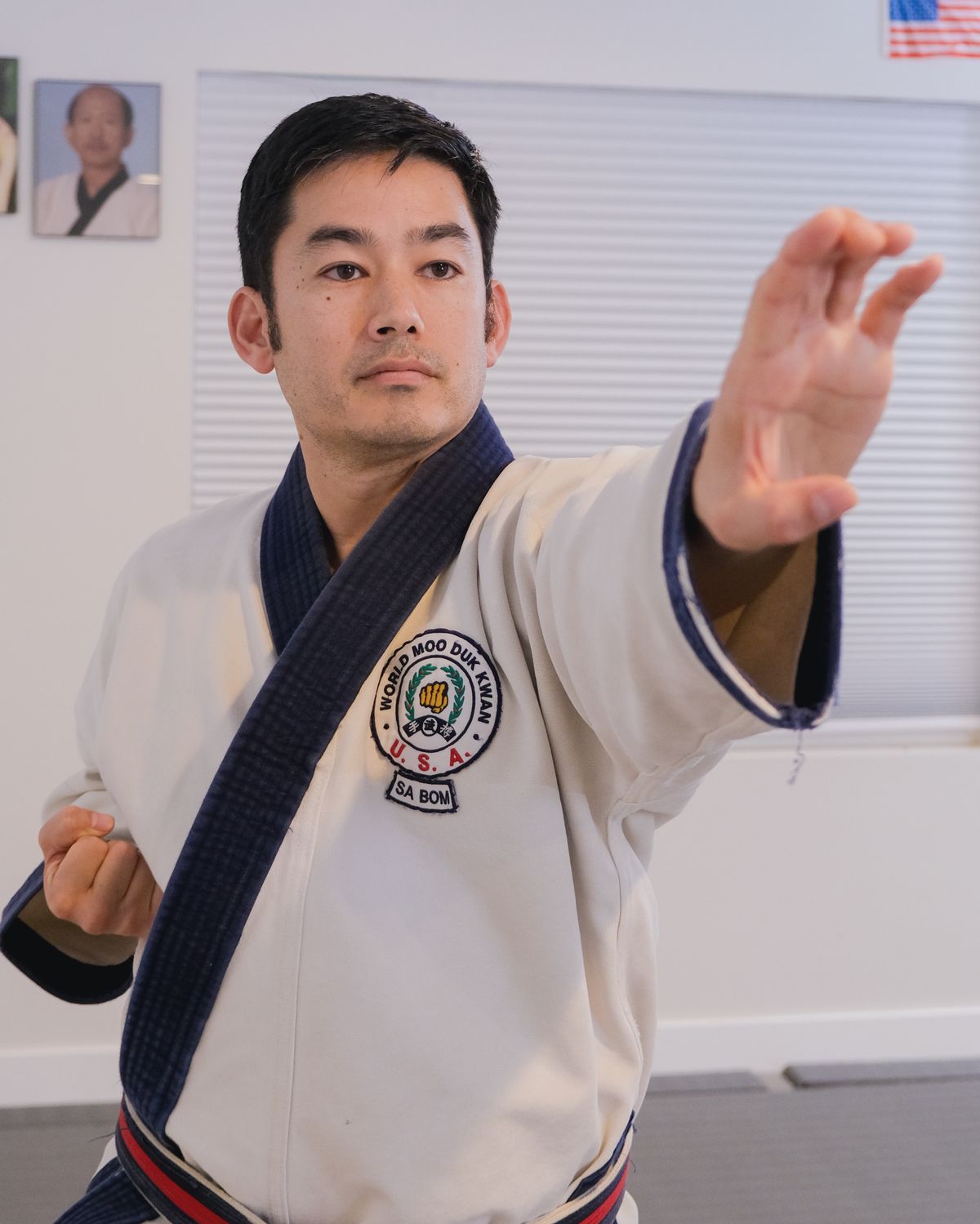
What's covered
Forms
Pyung Ahn Cho Dan, E Dan, Sam Dan and Sa Dan — each taught as a full walkthrough, a part-by-part breakdown, and a review lesson at the next rank.
Basics
Back stance (Hu Gul Jaseh), back kick, hand technique combinations, weapons of the hand, and a dedicated resistance training class.
Applications
One-steps, straight and cross wrist grabs, and Kyuk Pa breaking at every sub-rank.
Study materials
Korean terminology with audio at every rank, written requirement sheets, quizzes, and the philosophy behind the Korean flag.
Test preparation
A complete evaluation guide for each rank, ending with the evaluation to red belt itself.
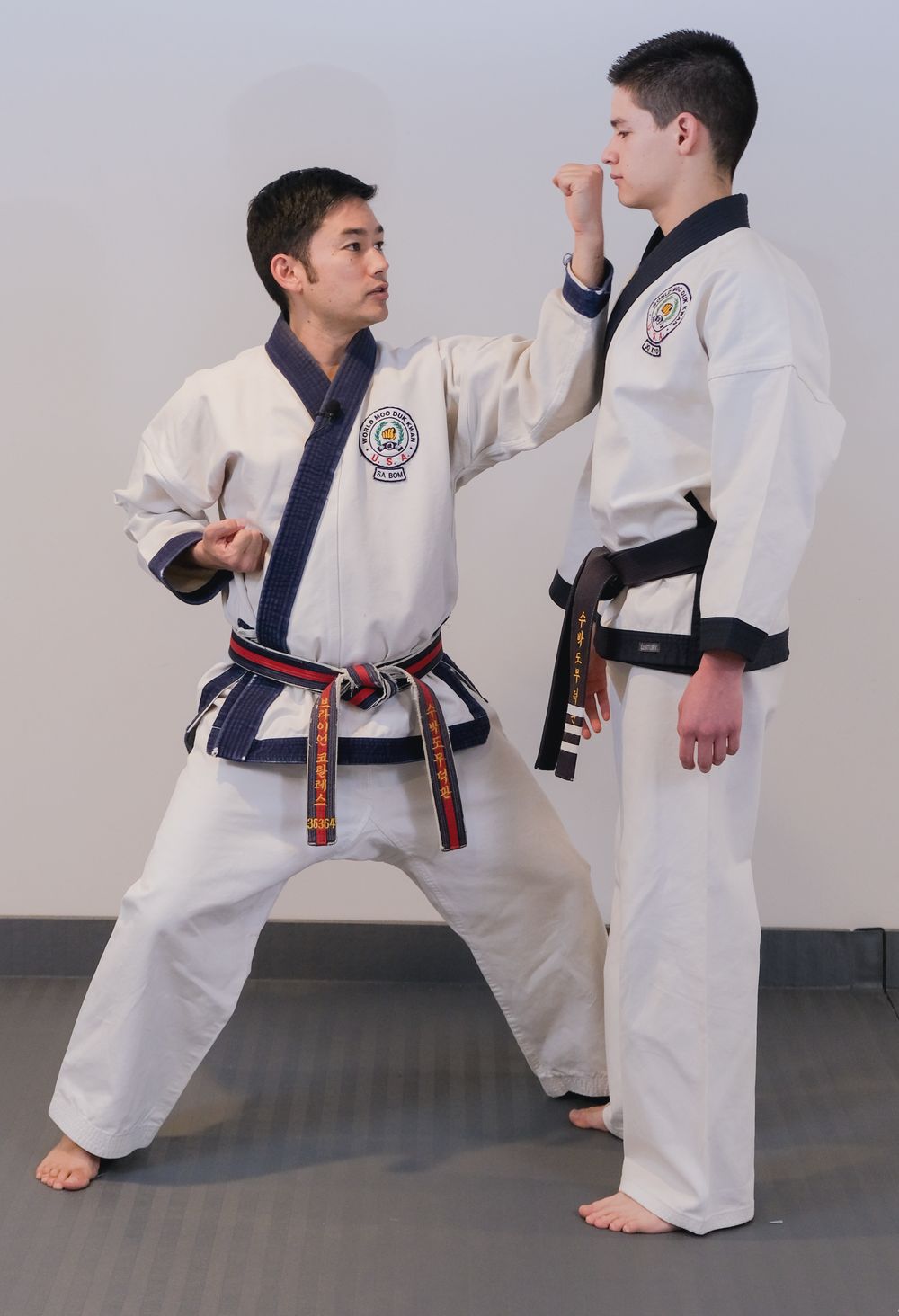
— Ho Sin Sul · Self Defense
Test for rank when you're ready
Rank evaluation is optional and sold separately. The curriculum stands on its own — plenty of students train it purely as reference, or to sharpen what they already practice elsewhere.
If you do want certified rank, every section of this course includes the full testing requirements for that level, the video submission standards, and a demonstration example. You'll receive a detailed evaluation from Brian Corrales, Sa Bom, with certification issued through Wasatch Martial Arts Academy under the World Moo Duk Kwan.
Learn about certificationWhat an evaluation involves
- Train consistently. Around two hours a week for three to four months at your current rank.
- Record your video. In uniform, full body in frame, with room to move freely.
- Demonstrate the basics. Blocks and strikes on both sides, kicks from both angles, following the format given in your rank section.
- Announce and perform your form. Name it, then run it, exactly as shown in the example video.
- Submit and receive feedback. A detailed evaluation of your performance, with certification on passing.
Certified rank requires membership in the US Soo Bahk Do Moo Duk Kwan Federation or your country's World Moo Duk Kwan affiliate. No membership is needed to take the course. One-steps, wrist grabs and breaking require a partner.

Your instructor
Brian Corrales, Sa Bom — 6th Dan
- Certified Sa Bom — master instructor
- USA Technical Advisory Committee
- Moo Duk Kwan Heritage Liaison, appointed 2021
- 20 years of teaching experience
- 35+ years of consistent training
Brian's background is in the system founded by Hwang Kee in 1945 — the source of both Tang Soo Do and Soo Bahk Do, and one of the roots of modern Tae Kwon Do. It draws on Okinawan karate, Tan Tui, Ba Duan Jin, Tai Chi and Kwon Bup as documented in the Moo Yei Do Bo Tong Ji.
Sa Bom is the highest teaching certification the art offers, designating a master model instructor. Brian holds two national appointments from Kwan Jang Nim H.C. Hwang.
Example Curriculum
- 6th Gup to 5th Gup Requirements
- Soo Gi - Hand Techniques (7:47)
- Back Kick (26:47)
- Pyung Ahn Cho Dan (0:59)
- Pyung Ahn Cho Dan Explained (2:41)
- Pyung Ahn Cho Dan Part 1 (2:17)
- Pyung Ahn Cho Dan Part 2 (3:00)
- Pyung Ahn E Dan (1:20)
- Pyung Ahn E Dan Part 1 (1:56)
- Pyung Ahn E Dan Part 2 (2:04)
- Pyung Ahn E Dan Part 3 (3:36)
- One Step 1-2 (2:24)
- One Step 3-4 (1:56)
- Cross Wrist Grabs (11:53)
- Kyuk Pa (10:07)
- Terminology
- Quiz
- Evaluation to 5th Gup (0:26)
- 5th Gup to 4th Gup Requirements
- Soo Gi - Hand Techniques (7:39)
- Jok Gi - Foot Techniques (13:22)
- Pyung Ahn Sam Dan (3:02)
- Pyung Ahn Sam Dan Explained (13:56)
- One Steps 3-4 (1:56)
- One Step 5-6 (2:49)
- Straight Wrist Grabs 1-4 (11:34)
- Kyuk Pa - Breaking (8:14)
- Philosophy of the Korean Flag
- Terminology
- Quiz
- Evaluation to 4th Gup (0:26)
- 4th Gup to 3rd Gup Requirements
- Soo Gi - Hand Techniques (3:06)
- Jok Gi - Foot Techniques (6:31)
- Pyung Ahn Sa Dan (1:09)
- Pyung Ahn Sa Dan Part 1 (3:54)
- Pyung Ahn Sa Dan Part 2 (1:15)
- Pyung Ahn Sa Dan Part 3 (1:49)
- Pyung Ahn Sa Dan Review Class (20:52)
- One Step 5-6 (2:51)
- One Step 7-8 (2:38)
- One Step 9-10 (3:21)
- 2 on 1 Wrist Grabs (12:20)
- Kyuk Pa - Breaking (11:52)
- Terminology
- Quiz
- Evaluation to Red Belt (3rd Gup) (0:26)
- Red Belt
Not sure you're ready to buy?
If you haven't trained before, start with Foundations — it's free, and it's the course I'd hand a brand-new student on their first night in the dojang. From there, White & Orange Belt takes you to green belt, and this course picks up exactly where that one leaves off.
No card, no trial period, no expiration on Foundations. If Soo Bahk Do turns out to be for you, you'll already know exactly how training works by the time you get here.
Start Foundations — free →Questions
Do I need Foundations and White/Orange Belt before starting Green Belt? ▼
What forms do you learn in the Green Belt course? ▼
Are the Pyung Ahn forms the same in Tang Soo Do and Soo Bahk Do? ▼
How long does it take to earn a green belt in Soo Bahk Do? ▼
Can I take this course without belonging to a martial arts organization or federation? ▼
What equipment do I need for the Green Belt course? ▼
Do I get lifetime access to the Green Belt course? ▼
THE ROAD TO BLACK BELT
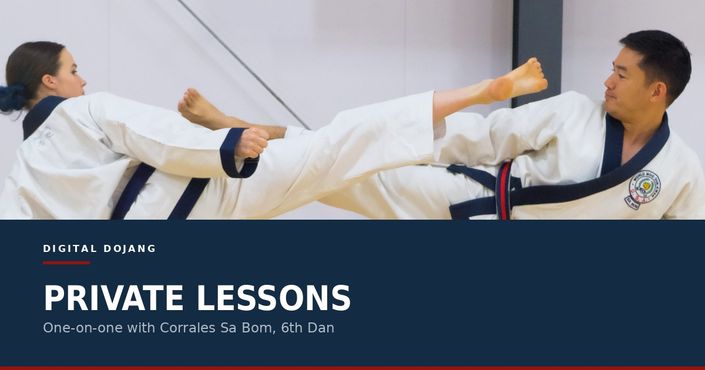
Red Belt picks up right where Green leaves off — three ranks and you're at Cho Dan. Save with the Black Belt Prep Bundle if you want the whole path in one purchase, or book a private lesson for one-on-one coaching along the way.