
FREE PREVIEW
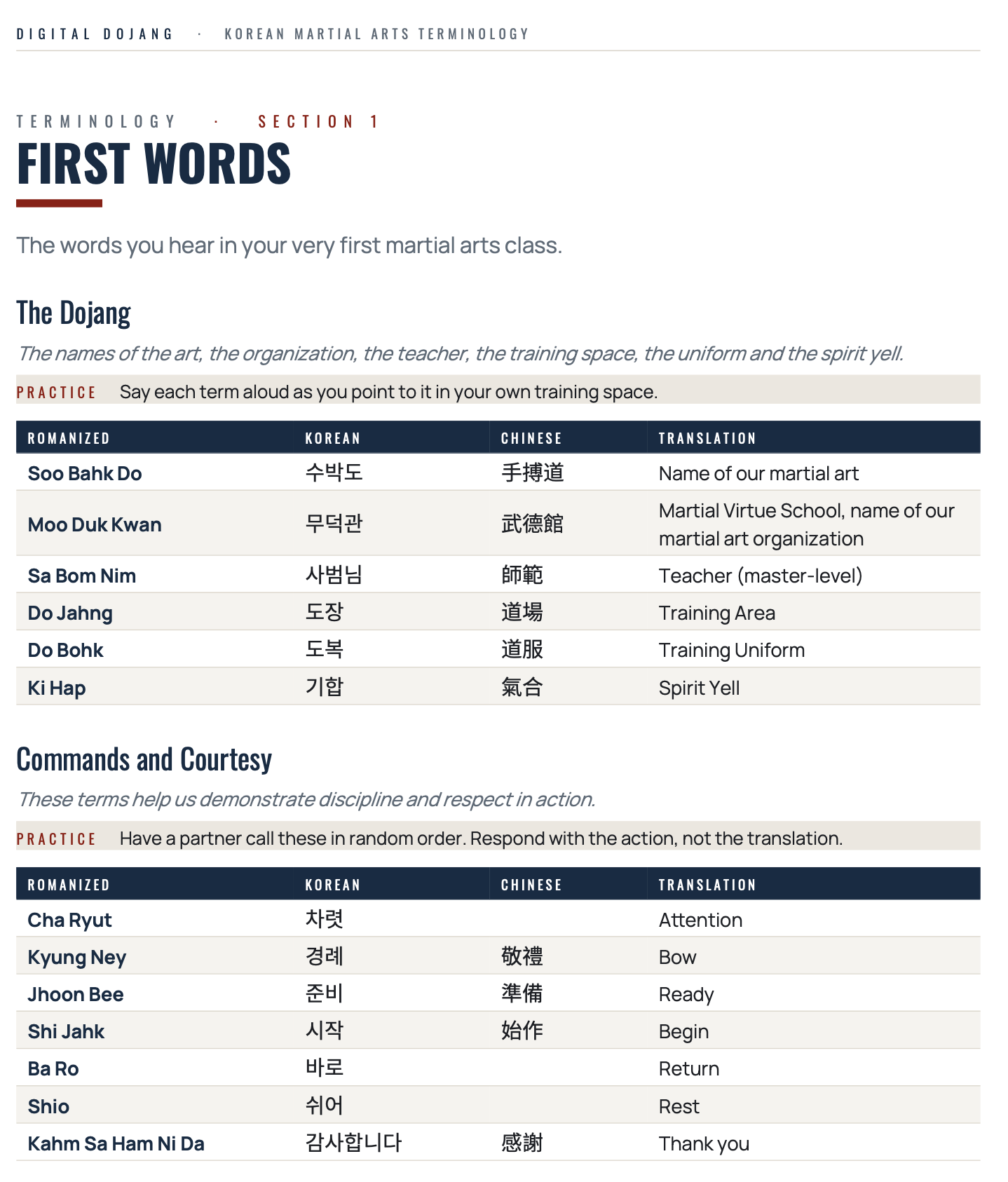
The first section is free as a printable sheet. Download First Words, learn the thirteen terms you'll hear in your first class, and see how the rest of the guide is taught.

The Korean language of the dojang, explained
Korean Martial Arts Terminology is a ten-section e-book of the Korean terms used in Soo Bahk Do and Tang Soo Do. Every term has its Korean (Hangul), its Chinese characters (Hanja) where they apply, and an English translation. Each section comes with an audio file recorded by a native Korean speaker, so you learn to say the words correctly from the start.
- 10 sections, from your first class to the language of lineage
- 187 terms with Hangul, Hanja and English
- 10 audio files recorded by a native Korean speaker
- A one-page guide to reading Hangul, so you can sound out the Korean yourself
- Instant download: a PDF e-book and ten MP3 files you keep
Learn the authentic terms used by Koreans in the early days of the Moo Duk Kwan. These terms are still used today in Moo Duk Kwan schools. Students of the Digital Dojang are expected to learn these terms and will be used during evaluations, weekly classes, and in person seminars.
A word list teaches you to memorize. This teaches you to understand.
Most terminology sheets give you a Korean word and an English word and leave the rest to memory. That works until the terms get longer, and then it stops working.
Korean technique names are built from small parts. Learn the parts and the long names start to read themselves. Each section groups terms so you can see the pattern, explains it in a sentence, and gives you a practice to do on the floor.
Example: Ha Dan (low) + Soo Do (knife hand) + Mahkee (block) = Ha Dan Soo Do Mahkee, 하단수도막기, low knife-hand block.
What's inside, section by section
- First Words: the dojang, class commands and courtesy (13 terms)
- The Building Blocks: the three actions, three levels and directions every technique name uses (13 terms)
- Your First Techniques: stances, blocks, punches, kicks and counting in Korean (27 terms)
- Respect and Ceremony: titles, flags, knife hand, and how class opens and closes (22 terms)
- Training With a Partner: sparring, self-defense, spinning kicks and Sino-Korean counting (20 terms)
- The Hand and the Mind: hand weapons, two new blocks and the 8 Key Concepts (17 terms)
- Structure and Values: members, two-handed techniques and the 5 Moo Do Values (17 terms)
- Moving With Purpose: advancing, mid-drill cues and a new family of kicks (14 terms)
- Effort and the Body: the three efforts, formal courtesy, specialized hands and anatomy (32 terms)
- Lineage and Expression: styles of the art, how technique is expressed, and advanced kicking (12 terms)
Choose the license that fits how you'll use it
Both licenses include the same e-book and the same ten audio files. The difference is who can use them. Your license is the one you purchase, and it appears on your receipt.
Individual and Household License $29
For students and families studying at home.
- Read, print and study the e-book yourself
- Share it with, and print copies for, everyone in your household
- Listen to the audio as often as you like
Instructor License $79
For instructors who want to support their students' study at home, alongside the program they already teach.
- Everything in the Individual and Household License
- Print copies and give them to the students you teach
- A ready-made home study resource for terminology, so class time stays on the floor
About the author
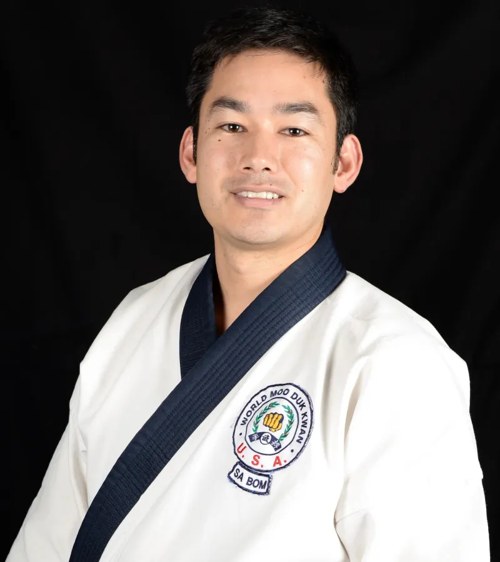
Brian Corrales, Sa Bom
- Certified Sa Bom, the master instructor certification in Soo Bahk Do Moo Duk Kwan
- US Federation Technical Advisory Committee
- Owner and chief instructor, Wasatch Martial Arts Academy, Salt Lake City
- 35+ years of training, 20 years of teaching
Brian's training comes from the Moo Duk Kwan system founded by Hwang Kee in 1945, the root of both Tang Soo Do and Soo Bahk Do. This guide is built from the terminology he teaches in his own dojang, organized the way he teaches it.
More about Brian
Questions about Korean martial arts terminology
What Korean terms do Tang Soo Do and Soo Bahk Do students need to know?
Students start with the words of the dojang and class commands: Cha Ryut (attention), Kyung Ney (bow), Jhoon Bee (ready) and Shi Jahk (begin). They then learn the parts that technique names are built from, such as Ha Dan (low), Mahkee (block), Kong Kyuk (attack) and Cha Gi (kick), followed by stances, counting, titles, sparring and the philosophy of the art. This guide covers 187 terms in that order, across ten sections.
Is this guide useful for Taekwondo and other Korean martial arts?
Yes. Many terms are shared across Korean martial arts, including counting, commands, levels, directions and the names for hands and feet. Some styles use different words or spellings for certain techniques. Because every term includes its Korean (Hangul), you can match it to the term your school uses even when the English spelling differs.
Do I need to know how to read Korean?
No. The guide includes a one-page introduction to Hangul, the Korean alphabet. It shows how letters combine into syllable blocks, with a chart of the basic consonants and vowels, so you can sound out every term in the Korean column. Every term is also written in English letters.
How do I learn to pronounce the Korean terms correctly?
Each of the ten sections has its own audio file, recorded by a native Korean speaker. Listen to the section, repeat each term out loud, then use it in your training.
Why does the guide include Hanja (Chinese characters)?
Many Korean martial arts terms come from Chinese characters, called Hanja. Seeing the characters shows what a term literally means and how related terms connect. For example, Soo (手) means hand, and it appears in Soo Do (knife hand), Kwan Soo (spear hand) and Soo Gi (hand techniques).
Why are some spellings different from the ones my school uses?
Korean can be written in English letters in several ways, and martial arts schools have never agreed on one system. This guide does not follow a standard romanization. If your school spells a term differently, use your school's spelling. The Korean is the same.
What is the difference between the two licenses?
Both include the same e-book and audio. The Individual and Household License covers you and the people in your household. The Instructor License also lets you print copies and give them to the students you teach, as a home study resource alongside your own program.
Can I print the e-book?
Yes. The Individual and Household License lets you print copies for your household. The Instructor License lets you print copies for your students. Printed copies must be complete and may not be sold.
What format is the e-book, and how do I get it?
The e-book is a PDF, and the audio is ten MP3 files. You can download everything right after purchase and keep it.
What is the refund policy?
Refunds follow the Digital Dojang refund policy.