BREATH · MOVEMENT · MOBILITY
Eight movements, practiced for nearly a thousand years
Pahl Dan Kuhm (八段錦, Eight Pieces of Brocade) is a set of eight standing exercises that pair slow movement with controlled breathing. A brocade is a valuable piece of silk, and the name is meant to tell you what these exercises are worth. They date back at least to China's Song Dynasty, where all eight postures appear, illustrated and described, in the Ten Compilations on Cultivating Perfection.
You may know them as Ba Duan Jin, the Chinese pronunciation of the same characters, from a Tai Chi or Qigong class. Grandmaster Hwang Kee, founder of the Moo Duk Kwan, brought them into Soo Bahk Do (Tang Soo Do) as Moo Pahl Dan Kuhm, the "martial" Eight Brocades. Despite the name, the focus is health rather than fighting.
This course teaches both versions, step by step: the set practiced in Moo Duk Kwan schools, and the traditional Ba Duan Jin. The full set takes about eight minutes.
Who this course is for
Martial artists of any style
A warm-up, a cool-down, or a recovery day. The breath control you build here is the same breath that powers a strong technique, whether you train karate, Taekwondo, Tang Soo Do, or kung fu.
Mature and returning students
Low impact, no jumping, no equipment. The movements work range of motion through the shoulders, spine, hips, and hamstrings at a pace you control, which is why they're a favorite with older practitioners.
Tai Chi and Qigong practitioners
You'll find the Ba Duan Jin you already know, taught posture by posture, alongside the Korean martial arts version. Seeing the two side by side is a useful way to understand what each movement is for.
WHERE IT STARTS
Breathing from the dan jun
Ho Hup Cho Chung (呼吸調中, breath control) is the foundation of every exercise in the set. The breath comes from the dan jun, a point about three inches below the navel. On the inhale it expands in every direction, the belly and the lower back together, the way a newborn breathes. On the exhale it contracts as the abdominal muscles tighten.
In the Moo Duk Kwan we describe sincere training as three efforts working together: Shim Gong (mental effort), Nae Gong (internal effort), and Weh Gong (physical effort). Right intention leads to right breathing, and right breathing moves the body. These exercises are where most students first feel that connection.
Three breaths you'll learn
Cleansing breath
In through the nose, out through the mouth, fully controlled.
Natural breath
In and out through the nose, relaxed and unforced.
Closing the breath
A complete inhale or exhale followed by a short, comfortable pause.
The eight movements
Each name is a short verse describing the movement and its purpose. You'll learn the posture, the breathing pattern, and how many repetitions to perform.
雙手擎天理三焦
1. Support the Heavens
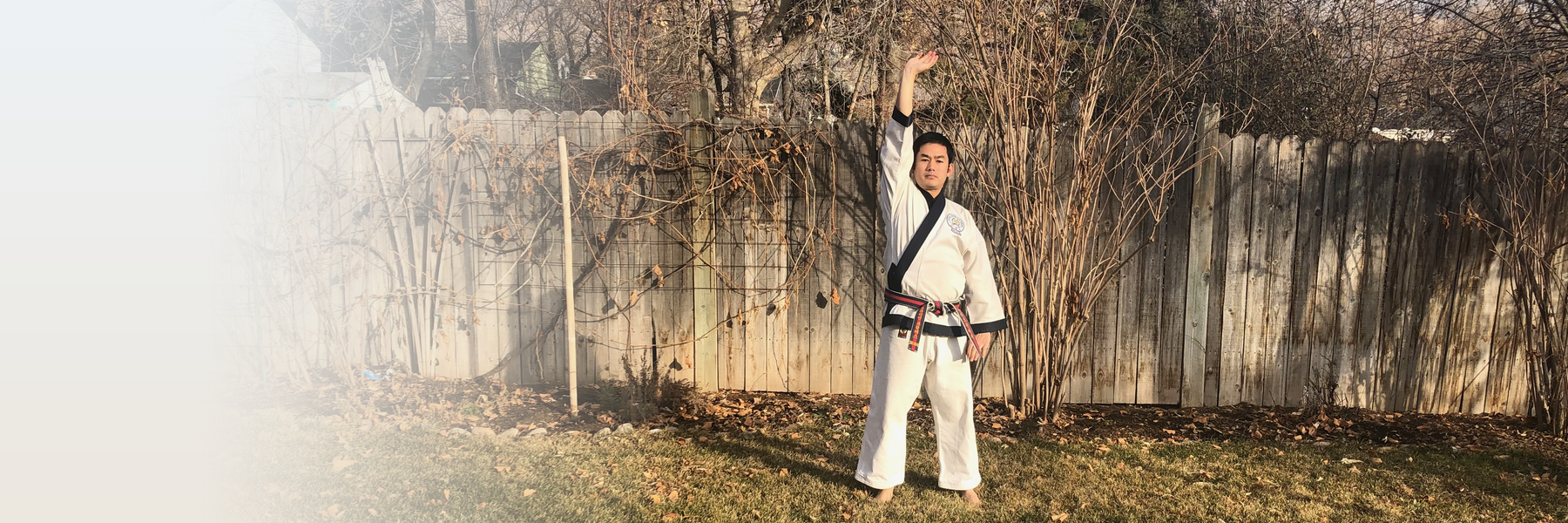
The arms rise overhead on a long inhale, opening the chest and warming the body for the rest of the set.
左右開弓似射雕
2. Draw the Bow to Shoot the Eagle
A stretch across the chest and a strong squeeze between the shoulder blades, held on the breath.
調理脾胃單擧手
3. Raise the Hand
One hand presses toward heaven and one toward earth, stretching the abdomen and the side of the rib cage.
五勞七傷向後瞧
4. Look Backward
A slow turn of the head with a spiral of the arms that works the full length of the spine.
揺頭擺尾去心火
5. Swing the Head and Tail
Circling the torso from a wide stance opens the hips and mobilizes the spine.
両手攀腳固腎腰
6. Hold the Feet
A supported back bend, then a slow fold for the lower back and hamstrings, rolling up one vertebra at a time.
握拳怒目增力氣
7. Punch with Angry Eyes
Slow punches from a deep stance, exhaling through each one and settling the breath low in the body.
背後七顛百病消
8. Shake the Back Seven Times
Rise onto the balls of the feet, then drop into the heels on the exhale to relax and settle the whole body.
The Moo Duk Kwan set also includes Extending Claws, Spreading Wings (出爪亮翅), a posture drawn from the Yuk Keun Kyung (易筋經, Changing Tendons Classic) that you won't find in most traditional versions. Because you learn both sets, you'll see exactly where they agree and where they differ.
What's in the course
22 video lessons, nearly three hours of instruction, and a printable handout.
SECTION 1 · ABOUT 33 MIN
Moo Pahl Dan Kuhm
The Moo Duk Kwan set, one lesson per exercise, then the full set performed start to finish. Includes the Ki Gong handout.
SECTION 2 · ABOUT 32 MIN
Ba Duan Jin
The traditional set as it's taught in Tai Chi and Qigong programs, with a history introduction, each posture, and the full series.
SECTION 3 · ABOUT 1 HR 42 MIN
Supplemental classes
A 30-minute follow-along class to practice with as often as you like, and a 75-minute seminar on the principles behind the set and how they carry into your technique.
Example Curriculum

YOUR INSTRUCTOR
Brian Corrales, Sa Bom — 6th Dan
I bring more than 35 years of martial arts training to these lessons. I teach the set as it's practiced in the Moo Duk Kwan, and alongside it the traditional Ba Duan Jin as described in the older Chinese sources, so you can see where each movement came from.
Sa Bom (master model instructor) is the highest teaching certification in Soo Bahk Do.
Frequently asked questions
Do I need any martial arts experience?
No. Every exercise is taught from the starting position up, and the breathing is explained before you begin. Experienced martial artists will recognize a few stances, but nothing in the course assumes prior training.
What's the difference between Ba Duan Jin and Moo Pahl Dan Kuhm?
They share the same roots and the same Chinese characters (八段錦). Ba Duan Jin is the Chinese pronunciation and the version most often taught in Tai Chi and Qigong programs. Moo Pahl Dan Kuhm is the name used in the Moo Duk Kwan, whose standardized set changes the order and adds a posture from the Changing Tendons Classic. The course teaches both.
Is this qigong?
Yes. Ki Gong, or qigong in Chinese, describes any exercise that joins breath with movement for the benefit of the practitioner, and the Eight Brocades are among the best known. The same exercises are practiced by Tai Chi and other internal martial artists.
How long does it take, and how often should I practice?
The full set takes about eight minutes. Traditionally it's done early in the morning, and daily practice is where the benefit builds. When you want a longer session, the 30-minute follow-along class is there to practice with.
Is it safe if I'm older or working around an injury?
The exercises are low impact and done at your own pace, which is why they're popular with mature students. Hold the breath only as long as is comfortable, never to the point of dizziness, and move the neck slowly. If you have a medical condition or injury, check with your doctor first. This course is exercise instruction, not medical advice.
What do I need?
Enough room to stand with your arms extended in every direction. No equipment, no uniform, and no mat.
Can my family use it too?
Yes. One purchase covers everyone in your household, and the exercises suit every age.
What if the course isn't right for me?
You can request a full refund within 7 days of purchase as long as no files have been downloaded. Once a file is downloaded, the sale is final.
詳推用意終何在 益壽延年不老春
"What is the purpose of the martial arts? Rejuvenation and prolonging of life beyond the normal span, so an eternal spring."
— The Song of Ship Sam Seh